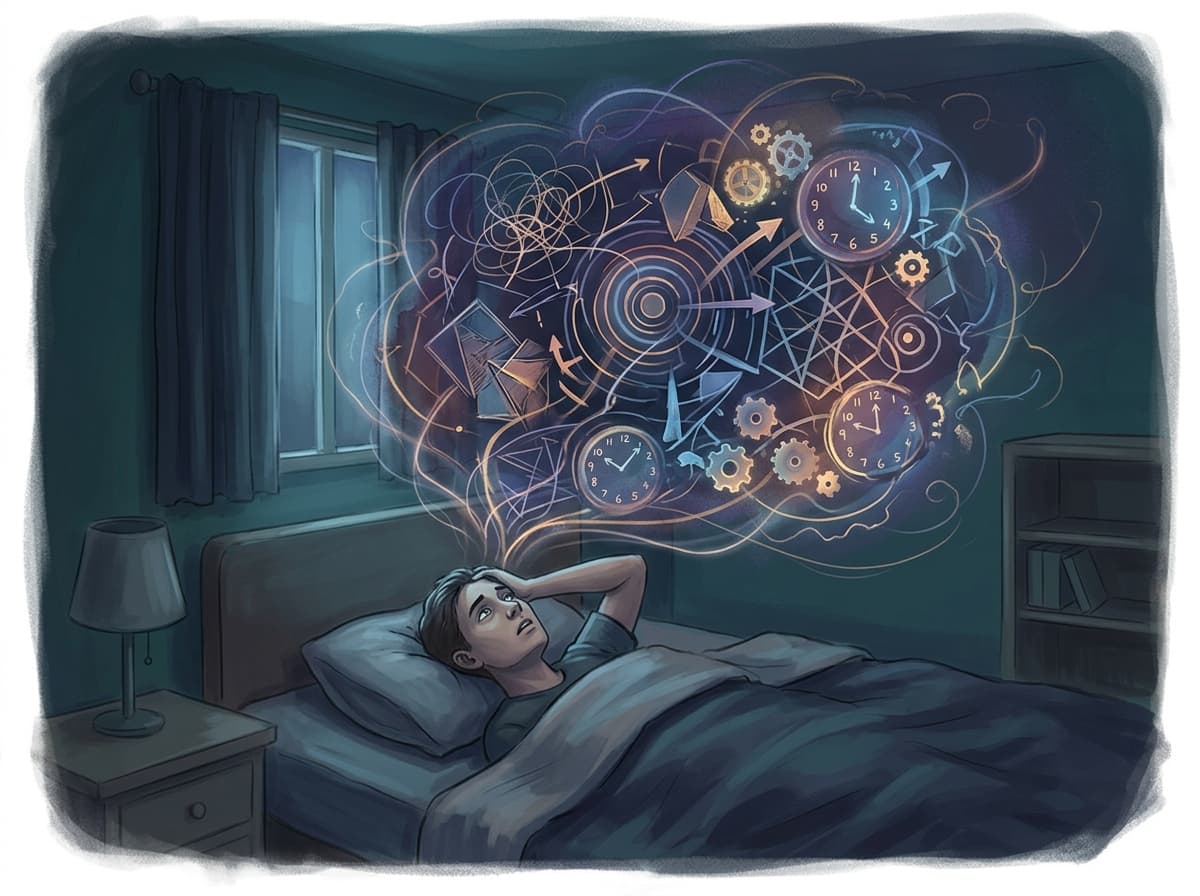
Your Mind Won't Stop—and You're Not Alone
Overthinking at night is when your mind races with repetitive thoughts, worries, and scenarios that prevent sleep. It's driven by anxiety, stress accumulation, and how your brain processes the day—not because you're weak or broken.
At night, your environment becomes quieter and you lose the distractions of the day. Your mind fills this silence by cycling through worries: Did I handle that meeting well? What if my boss thinks I'm incompetent? Why did I say that to my friend? Will I perform well tomorrow? These thoughts create anxiety, which keeps you awake, which makes the thoughts worse. It's a cycle.
This is especially common for Indian professionals who carry multiple stressors: work pressure, family expectations, financial concerns, social comparisons, and the constant availability culture. When you lie down at 11 PM, all these thoughts surface at once.
Here's what's important to understand: Overthinking at night is not insomnia (inability to sleep) and it's not laziness. It's anxiety expressing itself when you finally stop moving.
This guide explains why your mind races at night, what's actually happening in your brain, and specific techniques that work to calm the overthinking cycle. Most importantly, you'll learn that this is treatable—and you can sleep better starting tonight.
What's Really Happening: The Biology of Night Overthinking
Why Your Brain Does This at Night
During the day, you're busy. Your attention is divided across work, meetings, messages, decisions. Your brain is occupied.
At night, the external stimulation stops. Your brain doesn't turn off—it turns inward. With fewer distractions, it processes the day's stressors. If you've been anxious or stressed during the day, this processing becomes repetitive cycling through worries.
Neurologically, what's happening:
- Reduced external input — Quiet environment means your brain has less to focus on
- Heightened internal awareness — You notice every thought, every anxiety
- Activation of the default mode network — Your brain's self-referential thinking increases when you're not focused on tasks
- Amygdala activation — If you've experienced stress that day, your threat-detection system is still active
Your brain isn't malfunctioning. It's doing exactly what brains do when overstimulated and then suddenly unstimulated. The problem is the accumulation of stress without proper processing.
Why It's Worse for Indians Specifically
In Indian work and family culture, several factors intensify night overthinking:
- "Always on" culture — You're expected to be available for work messages until late. Your nervous system stays activated even after work ends.
- Multiple role stress — You're not just an employee; you're managing family expectations, marriage prospects (if single), in-law dynamics (if married), parents' health concerns. Your mind has multiple worry categories.
- Comparison culture — Social media and family networks constantly expose you to others' achievements. At night, your brain compares your progress to theirs.
- Repression of stress — Indian culture often expects you to "manage" stress silently without complaining. So stress accumulates unprocessed during the day and emerges at night.
- Sleep guilt — When you can't sleep, Indians often add guilt: "I should be sleeping, why can't I just relax?" This meta-anxiety makes overthinking worse.
Are You Overthinking at Night? The Signs
Clear Signs of Night Overthinking
- You lie down at 10-11 PM but your mind immediately becomes active
- Thoughts cycle repeatedly (same worries loop over and over)
- You can't control the thoughts—they just keep coming
- Worries feel urgent and unsolvable at night (but seem manageable in daylight)
- You feel physically restless (can't get comfortable)
- Time passes without awareness—suddenly it's 1 AM
- Thoughts include "what-if" scenarios and regrets from the past
- You catastrophize: small issues become worst-case scenarios
- You go through the same mental loops multiple times
- Sleep finally comes from exhaustion, not relaxation
Reality check: If your mind races but you still sleep reasonably well, it's overthinking. If you lie awake for hours, it may be insomnia (which overthinking can cause).
The Overthinking Cycle: How It Traps You
Step 1: Trigger
Something during the day creates stress or anxiety. Maybe a difficult interaction with your boss or partner, receiving critical feedback, uncertainty about the future, comparing yourself to others, or unfinished work or decisions.
Step 2: Accumulation
You push the stress aside during the day because you're busy. You tell yourself: "I'll think about it later" or "Let's get through this day first." The stress doesn't disappear—it accumulates in your nervous system.
Step 3: Night Activation
At night, with nothing to distract you, your brain retrieves all these stored stressors. It begins processing them—but without the solution-finding resources you have during the day. At 11 PM, your prefrontal cortex (problem-solving brain) is tired.
Step 4: The Rumination Loop
Your brain gets stuck. It cycles through the same worry, looking for resolution:
- "What if I mess up the project?" → generates anxiety
- Anxiety triggers more worried thoughts
- More thoughts = feeling more awake
- Feeling awake = trying harder to solve the problem mentally
- Trying harder = more mental activity
- More mental activity = more wakefulness
You're now trapped in a loop. And the harder you try to sleep, the worse it gets.
Step 5: Sleep Deprivation Feedback Loop
Poor sleep → reduced emotional regulation during the day → more stress → more overthinking → worse sleep. You're now caught in a cycle that needs intervention to break.
Why You Can't "Just Stop Thinking"
People often say: "Just stop thinking about it" or "Clear your mind." This doesn't work. Here's why:
The Paradox of Thought Suppression — When you try to not think about something, you think about it more. Research shows that instructions to "not think about X" actually increase thoughts about X. Your brain treats the suppression attempt as a reminder.
Racing thoughts aren't voluntary — You're not choosing these thoughts. They're happening automatically because your nervous system is in a heightened state. You can't just willpower your way out.
You need to regulate your nervous system, not control your thoughts — The solution isn't mental discipline. It's changing your nervous system state so the racing thoughts naturally decrease.
Proven Strategies That Actually Work
Strategy 1: Process Stress During the Day (Prevention)
The best way to reduce night overthinking is to prevent the stress accumulation in the first place.
How to do it:
1. Create a "worry time" during the day (15 minutes, 3-5 PM)
- Set aside 15 minutes in the afternoon
- Write down everything that's worrying you
- Don't solve it—just externalize it (write it down)
- Close the notebook when the 15 minutes end
- Tell yourself: "I'll address this during worry time tomorrow if it comes up again"
2. Have one conversation or journal entry about your day
- Before dinner, spend 5-10 minutes talking to someone or writing about your day
- Include what went well and what felt difficult
- This processes the day instead of letting it stack up
3. Set a "decision deadline"
- If you're overthinking a decision, decide on a specific day you'll make the choice
- Tell yourself: "I'm deciding this Thursday. Until then, I'm not going to think about it."
- Your brain releases the thought when it knows when it will be addressed
Strategy 2: Interrupt the Loop Before Bed (Prevention)
The 10-Minute Brain Dump (Do this 30 minutes before bed)
- Get a notebook or your phone
- Write down or type every thought in your head—no editing, no order
- Include worries, tomorrow's tasks, regrets, ideas, anything
- Set a timer for 10 minutes and keep going until the timer ends
- Close the notebook. You've externalized your thoughts.
The "Thought Parking Lot"
If a specific worry surfaces at night:
- Acknowledge it: "I notice I'm thinking about the meeting tomorrow"
- Don't fight it or analyze it
- Say to yourself: "That's parked. I'll think about that at 3 PM tomorrow during worry time"
- Redirect your attention to your breath
Strategy 3: Regulate Your Nervous System (In the Moment)
The 4-7-8 Breathing (Immediate Calm)
This is evidence-based. It works within 2-3 minutes.
- Close your mouth
- Breathe in through your nose for a count of 4
- Hold your breath for a count of 7
- Exhale through your mouth for a count of 8
- Repeat 4 times
The Body Scan (Shift Attention from Thoughts)
When thoughts won't stop, shift attention to your body:
- Lie still
- Focus on your toes—feel them
- Move your attention up: feet, ankles, calves, knees, thighs, torso, chest, shoulders, arms, hands, neck, face
- Spend 5 seconds noticing each area
- By the time you reach your head, thoughts have usually quieted
Temperature Reset
If you're lying awake, your body temperature might be too warm (which increases alertness).
- Get up briefly
- Splash cold water on your face or take a 2-minute cool shower
- This resets your body temperature and signals to your nervous system that it's time to sleep
- Return to bed
Strategy 4: Change Your Thought Pattern (Cognitive Shift)
From Catastrophizing to Realistic
When your mind goes to worst-case scenarios, interrupt it. Ask yourself three questions:
- Is this thought true? "I made a small mistake in the email" — True. "I'll lose my job because of it" — Probably not true.
- What's the evidence for and against this thought? Against: I've made small mistakes before and nothing happened. My boss has given me positive feedback.
- What's actually most likely to happen? Most likely: I'll correct the email, my boss will see it as normal. Replace the catastrophe with the likely outcome.
Acceptance Instead of Fighting
Instead of "I need to stop thinking about this," try: "My mind is producing worried thoughts tonight. That's okay. Thoughts are just thoughts, not facts. I can notice them without fighting them." This reduces the anxiety about the anxiety, which reduces the overall activation.
Special Factors for Indian Professionals
1. The "Juggling Multiple Roles" Factor
Indian professionals often carry stress from work performance, boss relationships, team dynamics, marriage/relationship expectations, parent's health, in-law dynamics, and social status. This creates multiple worry categories.
Solution: Weekly role-by-role check-in. Once weekly (Sunday evening), spend 10 minutes reviewing each role. Work: What went well? Family: Is there anything I need to address? Address each briefly so your mind doesn't cycle through them all night.
2. The "Always Available" Factor
You can't fully relax if you expect a work message at 11 PM.
Solution: Digital boundary. Set a clear boundary: "Work communication ends at 7 PM". Put your phone in another room after 9 PM. Your nervous system can only relax if it knows it's safe from work interruptions.
3. The "Comparison and Status" Factor
Social media and family networks create constant comparison. At night, this surfaces as anxiety.
Solution: Limit social media 2 hours before bed. Your brain needs to decompress from comparison mode. The anxiety from comparison continues into night if not given a buffer.
When to Seek Professional Help
See a mental health professional if:
- Night overthinking has continued for more than 3 months
- It's affecting your work performance or relationships
- You've tried these strategies consistently and they're not helping
- You're experiencing panic or severe anxiety at night
- You're using alcohol or medication to sleep every night
- You feel hopeless about your sleep situation
This is not weakness. Chronic overthinking at night often benefits from professional support. A therapist can help you identify root causes and teach you personalized techniques.