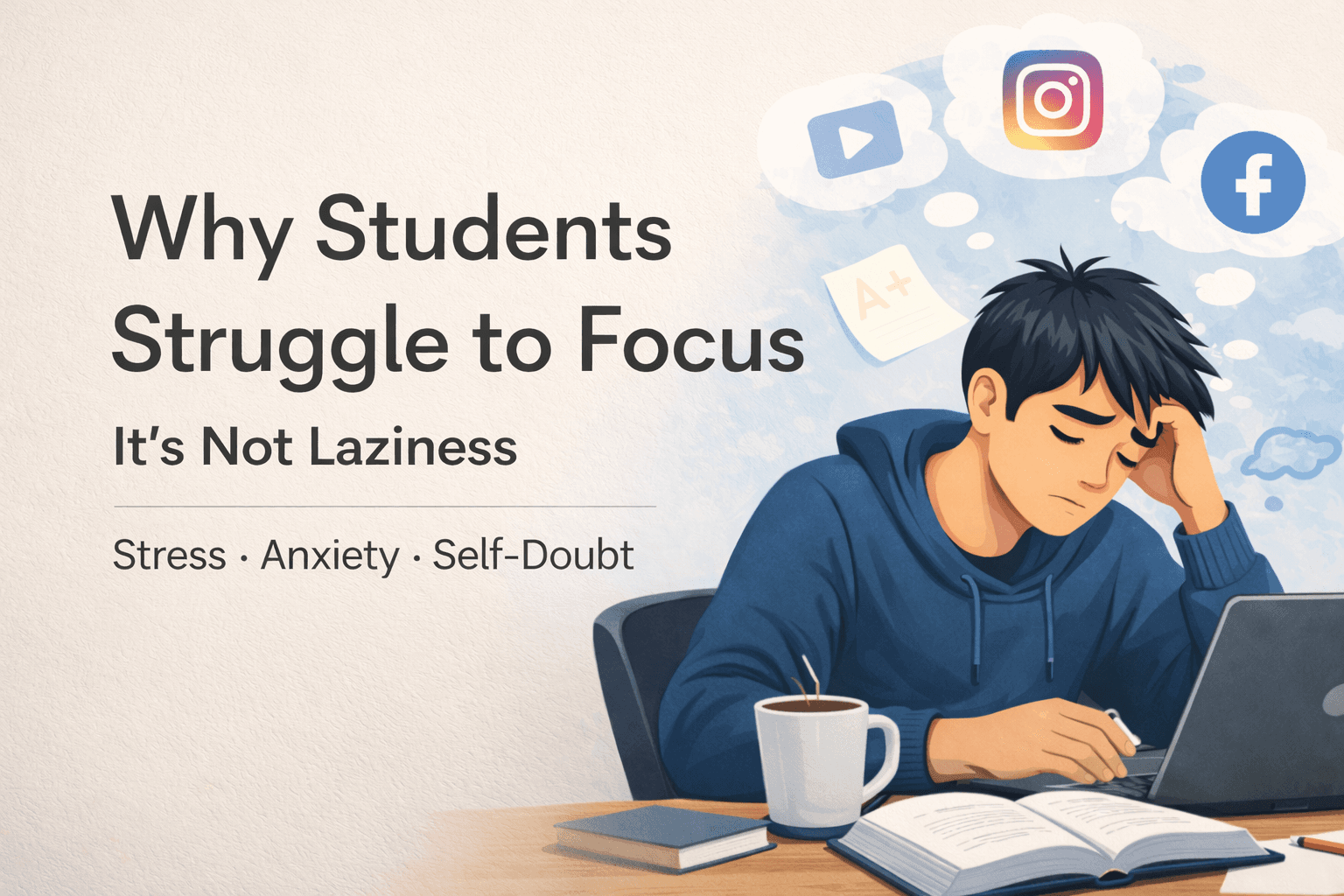
Why Students Struggle to Focus While Studying (It's Not Laziness)
A Psychological Explanation for Why Students Cannot Focus While Studying, Especially During Exam Stress and Burnout
Across schools, colleges, and competitive exam environments, one concern is increasingly common: students struggle to focus despite wanting to study.
"I sit down to study, but I just can't focus."
Books are open.
The laptop is ready.
The syllabus is clear.
Yet within minutes, concentration breaks down.
Social media feels tempting.
Unrelated thoughts appear.
Mental fatigue sets in even before meaningful effort begins.
Over time, many students internalize this experience and conclude:
From a mental health perspective, this assumption is often incorrect.
In most cases, difficulty concentrating is not a problem of motivation or discipline. It reflects how the brain responds to prolonged academic pressure and psychological stress.
In simple terms, it is a mental safety issue, not laziness.
Focus Problems in Students: What's Really Happening Psychologically?
From psychological and neurological research, the human brain does not prioritize productivity. Its primary function is survival.
When the brain senses uncertainty, pressure, or emotional threat, it enters a protective mode. In this state, sustained focus, memory retention, and deep learning become difficult.
For students, perceived threats often include:
Although these threats are not physical, the brain processes them as real and urgent.
As a result, students may experience:
This stress-driven mental state is commonly known as survival mode.
Survival Mode vs Laziness: Understanding the Difference
A major reason students mislabel themselves as lazy is a misunderstanding of survival mode.
| Laziness | Survival Mode in Students |
|---|---|
| Lack of concern | Excessive concern and overthinking |
| No emotional load | High emotional and cognitive pressure |
| Indifference | Fear of failure and long-term consequences |
Most students facing focus issues care deeply about their goals. Their difficulty arises from nervous system overload, not lack of effort.
Why Forcing Discipline Increases Focus Problems
To overcome concentration issues, students often attempt strict discipline:
Unfortunately, this approach increases internal pressure.
Excessive pressure activates stress responses, which interfere with learning and memory.
This often leads to a repeated cycle:
This cycle is a major contributor to student burnout, exam anxiety, and declining confidence.
A Science-Based Solution: Reduce Pressure to Improve Focus
Research consistently shows that focus improves when psychological safety increases.
One effective method is the use of low-pressure micro-goals.
Instead of overwhelming goals like:
Students benefit more from goals such as:
"This task is safe. There is no immediate danger."
As the brain perceives safety, focus gradually returns.
Focus cannot be forced.
Focus emerges from psychological safety.
Overstimulation and Its Impact on Student Focus
Modern students are exposed to constant digital stimulation:
This reduces the brain's tolerance for:
Discomfort during studying does not mean inability. It often indicates a brain recovering from overstimulation.
This condition is reversible.
How to Build a Safer Study Environment
"Why can't I focus?"
"How can I make this task feel safer and smaller?"
Helpful strategies include:
Final Takeaway for Students and Aspirants
When pressure reduces, mental clarity improves.
Focus does not come from force.
Focus comes from safety.
Take the First Step Toward Better Focus and Mental Well-Being
If you are struggling with focus, exam stress, or burnout, you are not alone.
At Catalyst Care, we help students understand their mental patterns, reduce stress, and rebuild sustainable focus through evidence-based mental wellness support.