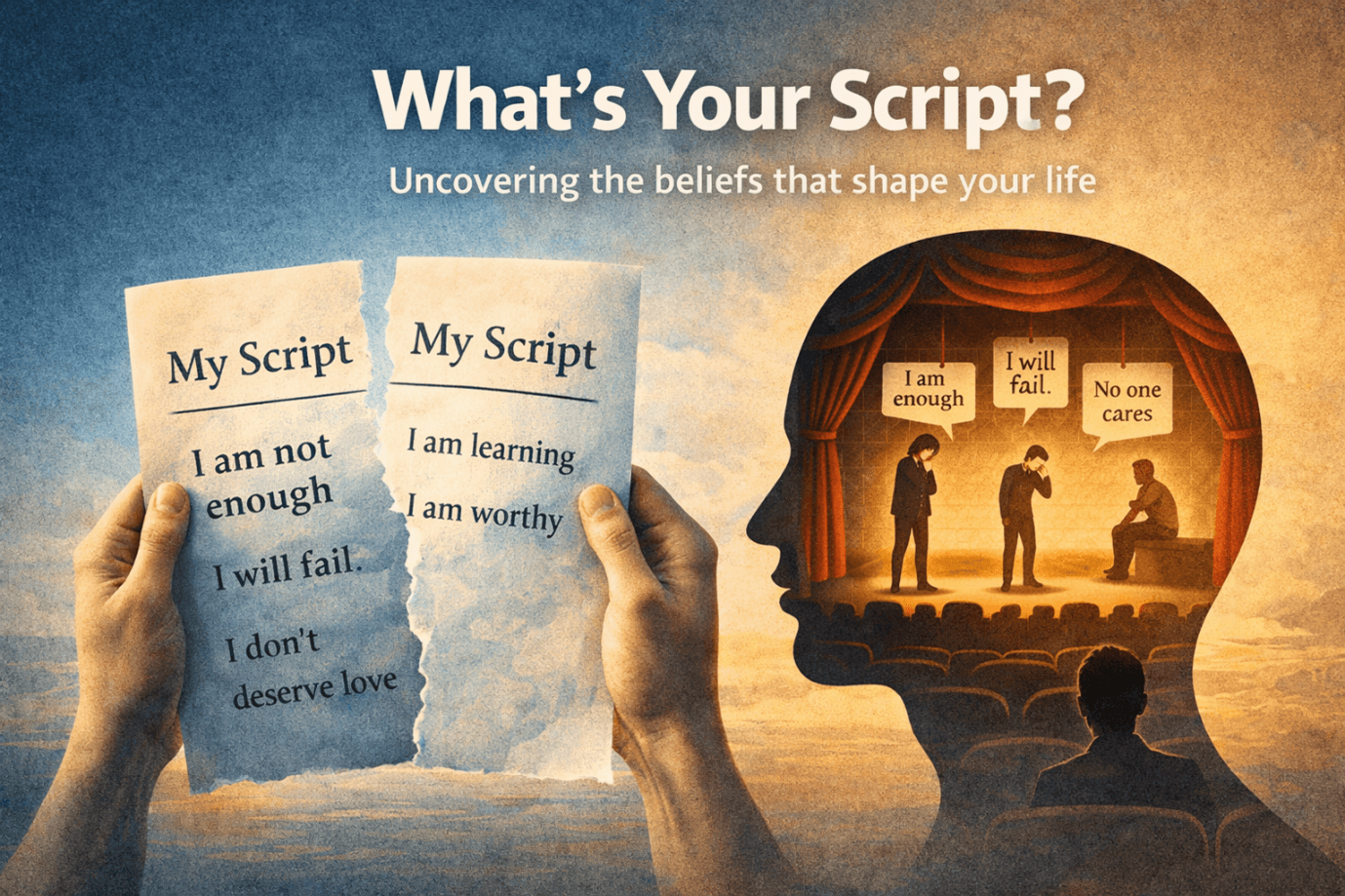
What’s Your Script?
Padmaja was speaking animatedly about her troubled marriage. She described how her mother-in-law had been verbally abusive and how her husband had never stood up for her.
Her mother-in-law passed away eight years ago, yet the intense conflicts between Padmaja and her husband continue even today.
As I listened carefully, I wasn’t just paying attention to her words - I was also observing the deeper, often invisible patterns shaping her story.
At the core of her experience were two powerful beliefs:
These internal scripts were silently influencing how she perceived and responded to her marriage.
We All Carry Scripts
Padmaja is not alone.
Sushant carries the belief “My future is doomed” after not getting into his preferred college.
Anjali holds onto “I can’t get what I want”, especially when dealing with her teenage son’s behavior.
Arnav lives with the deep-rooted belief “I don’t deserve love”, shaped by losing his mother at a young age.
Whether we realize it or not, all of us carry internal scripts - beliefs about ourselves, others, and the world.
Sometimes we are aware of them. Often, they operate quietly in the background, shaping how our lives unfold.
The problem arises when we hold onto these scripts too rigidly. Instead of helping us, they begin to limit us.
How Scripts Limit Us
For example, someone who believes “I am a failure” is less likely to put in consistent effort.
After all, if failure feels inevitable, why try at all?
This leads to an important question:
Why do we hold onto these scripts so strongly?
The Science Behind It
To understand this, we need to look at human evolution. As a species, we are wired primarily for survival - not necessarily for growth or thriving.
Painful or overwhelming experiences leave deep emotional imprints. Our minds try to make sense of these experiences by forming mental templates.
These templates - often called schemas - help us understand the world and respond quickly to situations.
In many ways, they act as psychological survival tools.
However, the same scripts that once helped us cope can later become obstacles if we continue relying on them long after the original situation has passed.
Arnav’s Story
When Arnav was eight years old, he lost his mother. Such a loss at a young age is deeply traumatic.
To cope, his mind formed beliefs around abandonment and unworthiness.
Today, Arnav is 28. He has a loving partner and a stable career. On the surface, his life looks successful.
Yet, even small conflicts - like a disagreement with his wife or feedback from his boss - trigger his old fears.
It’s as if his internal scripts never updated. A part of him is still that eight-year-old child.
Self-Fulfilling Patterns
Many people believe their scripts are still true because they can find evidence to support them.
And that’s where the real challenge lies.
Our brain is wired to seek familiarity. So, we unconsciously create situations that confirm our existing beliefs.
If Arnav never addresses his fear of abandonment, his insecurities might push his partner away.
And if that happens, he may say:
“I knew it - I don’t deserve love.”
This is how scripts become self-fulfilling prophecies, repeating dysfunctional patterns in our lives.
The First Step Toward Change
The first step toward change is awareness.
When we begin to notice the beliefs shaping our reactions, we create space to question them.
Through therapy or honest self-reflection, we can start rewriting these scripts.
Ask yourself:
Rewriting these scripts does not mean ignoring the past.
It means updating our internal stories so they reflect our present reality - not just our past wounds.
A Final Thought
The stories we carry within us shape our lives in powerful ways.
You create your scripts - and your scripts create you.
When you choose to question and rewrite them, you open the door to growth, healing, and new possibilities.